Our Product Principles
These Product Principles define what a good product means at SmartHR today.
Great products come from great teams and meaningful dialogue. We established these principles as a shared language to encourage conversation among everyone involved in our products, so we can deliver greater value to society, in better ways.
These are not strict rules to judge success or failure, but rather policies that underpin our daily decision making. We use them as a guide for our teams to discuss how we can make our products even better and find the best solutions for each moment.
We review and update these principles regularly to stay aligned with the changing world around us.
Last Updated: February 25, 2026
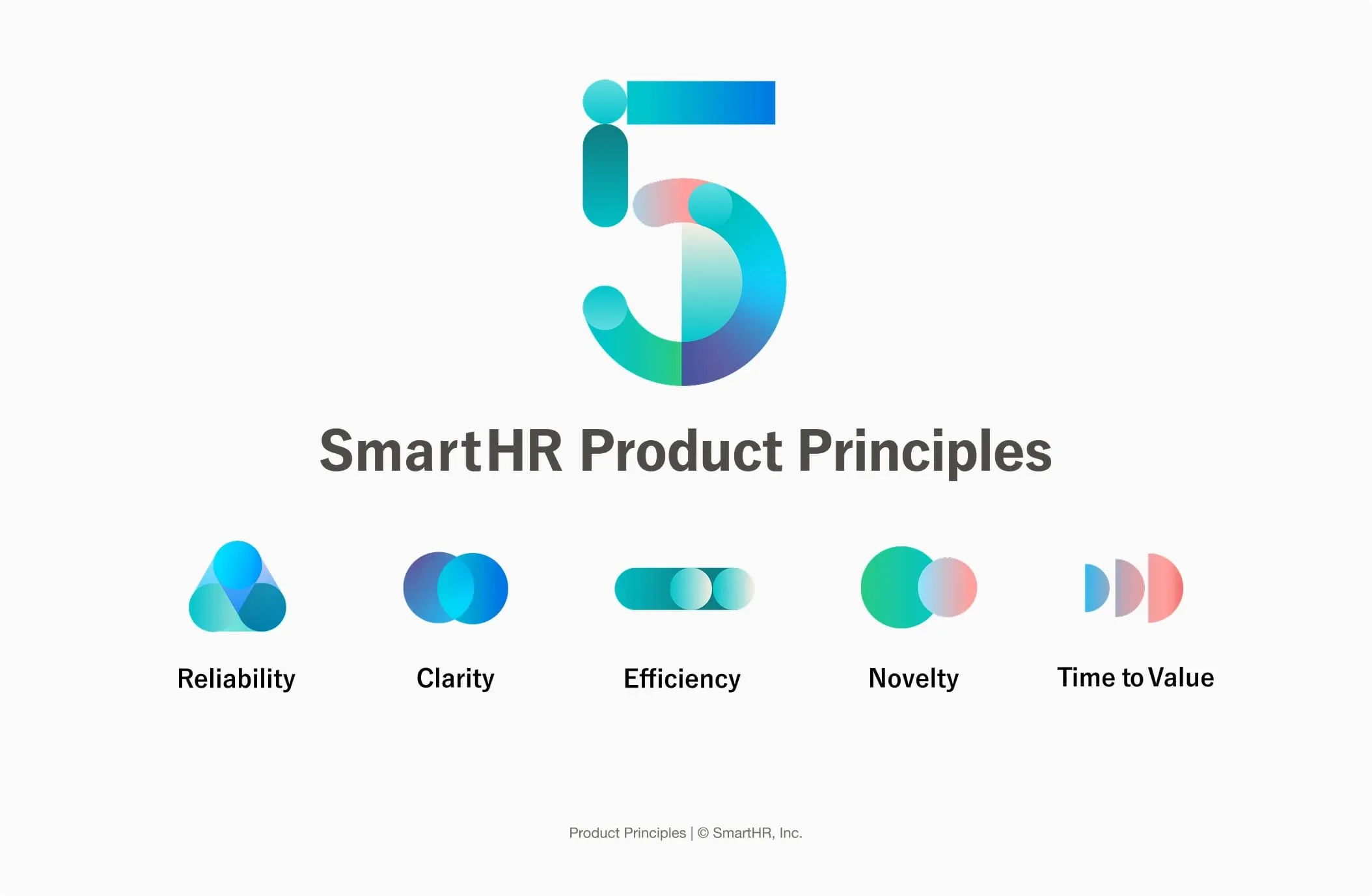
Five Product Principles
1.Reliability
Safety and Security as Social Infrastructure
For our products to serve as a trustworthy part of social infrastructure, we actively maintain product quality by delivering reliable, uninterrupted performance, robust data protection, and fast response times.
SmartHR is already used by millions of people and is becoming a vital part of the infrastructure for workers across Japan. Protecting their data and ensuring their work is never interrupted is our most important responsibility.
- Are we prioritizing speed of release at the cost of reliability?
- Did we discuss the trade-off between development speed and maintainability with the right stakeholders?
- Did we identify risks and conduct quality assurance (QA) appropriate for those risks before release?
- Is data preserved in the event of an emergency, and can we identify the cause and impact through logs?
- Are we incorporating feedback from internal and external experts regarding security, data privacy, and legal compliance?
- Are we setting and following reasonable Service Level Objectives (SLOs) for our users?
- Have we accounted for the large scale data input and high concurrent traffic expected from our enterprise users?
- Are we confirming that the information provided to users is up to date and accurate?
2.Clarity
Information Design That Removes Doubt and Anxiety
We ensure high usability and accessibility, making every operation predictable to minimize user effort and promote confidence.
For products handling sensitive information, peace of mind is the foundation of usability, and this comes from predictability. We must be aware of our biases as creators and objectively evaluate whether users can operate the product without confusion.
- Is it clearly communicated to the user what can be done within the product or on the screen?
- Can users predict what will happen after they perform an action?
- Are we immediately communicating the status of processes and results using simple language that users understand?
- Do we have proper guardrails and confirmation steps to prevent unintended data changes or deletions?
- Is the product designed to be intuitive for first-time users, free from proprietary jargon or complex technical concepts?
- Do we provide clear information on how personal data is handled, ensuring users feel confident entering it?
- Are we validating these points with actual users and usability & accessibility experts, rather than relying solely on the development team's internal perspective?
3.Efficiency
Efficiency Built Around the User
We provide the most efficient means for users to achieve their goals, putting aside any internal organizational or product structure constraints.
Users don't come to SmartHR to “operate” software, they just want to get their work done. And users will only continue choosing our products if we remove the unnecessary steps created by our own systems and needs, giving them the shortest path to their goal.
- Is the feature aligned with the user's workflow, rather than our repository structure, database, or team boundaries?
- Are there any areas where we are asking users to re-enter information they already provided in other parts of the product?
- Do we understand the user's work as a comprehensive, end-to-end process rather than isolated tasks? Have we considered optimizing all steps, including those that occur outside the product?
- Have we considered if the task itself can be eliminated or automated?
- Are terms, interactions, and support content consistent across different products to reduce the user's cognitive load?
- Are we prioritizing ease of development at the expense of forcing users into inconvenient workarounds?
4.Novelty
Create New Value by Understanding Context
By looking at the broader context beyond what users ask for on the surface and imagining the ideal outcome for them, we can create much greater value than what existing solutions can provide.
As society and technology continue to evolve, there are always unmet needs or better ways of doing things. Our competitive advantage comes from questioning assumptions, rethinking conventional approaches, and exploring bold ideas.
- Are we understanding the underlying problem behind the user’s request, not just the request itself?
- Are we narrowing the scope too early by assuming certain problems are “not ours” to solve?
- Are we building something users truly want, or just matching competitors feature for feature as if to fill out a comparison spreadsheet?
- Have we first imagined the absolute ideal user experience before limiting ourselves to what feels realistic today?
- At the concept or demo stage, does this make users say, “I want this now”?
5.Time to Value
Help Users Succeed Sooner
A good product is easy to adopt, easy to put into use, and quick to deliver meaningful value.
Our goal is not just to build something, but to create real, positive value. Measuring how long it takes users to reach that value helps us improve both the product and the business.
- Are we looking not only at usage rates, but also at how long it takes users to start using the product?
- Do we have metrics to measure not only whether the product is being used, but also whether users are actually experiencing its value?
- Can users begin using the product, even in a limited way, without requiring extensive upfront setup or manual study?
- Have we identified and addressed points in the setup process where users are likely to get confused or give up?
- Are we narrowing our target so much that the product becomes “too difficult to master” for other users?
- Are we using “the person responsible for implementation is too busy” as an excuse? Solving that is part of our job.
Voices From the Product Team
Voices From the Product Team
Hear from the people building SmartHR.